AI OCR Ultimate Optimization - Tenfold Accuracy Leap
Through the multi-perspective cross-validation architecture, the accuracy of document recognition is increased from 60-70% to 90-95%, achieving a qualitative change in professional-level data processing.
90-95%
Data can be trusted directly
<5%
Abnormal rate
10x
Improved accuracy
Project Challenge
A large number of receipts, invoices and financial documents are processed every day. Traditional OCR performs well under ideal circumstances, but when faced with complex scenes in the real world - faded thermal paper, handwriting, reflective card sleeves, folded invoices - the accuracy will drop significantly.
The recognition results of the same document may be inconsistent under different lighting, angles, and materials. A deviation in a single number may enter the financial system, causing knock-on effects on subsequent reconciliations. The customer needs aA solution that maintains high accuracyin all environments.
Smato solution
We designed a setMulti-perspective cross-validation architecture, the core idea is:
Multiple independent perspectives
Multiple models can be identified independently without interfering with each other
Cross-validation
Compare the results from each perspective and mark the differences
In-depth analysis
Automatically trigger depth recognition when inconsistent
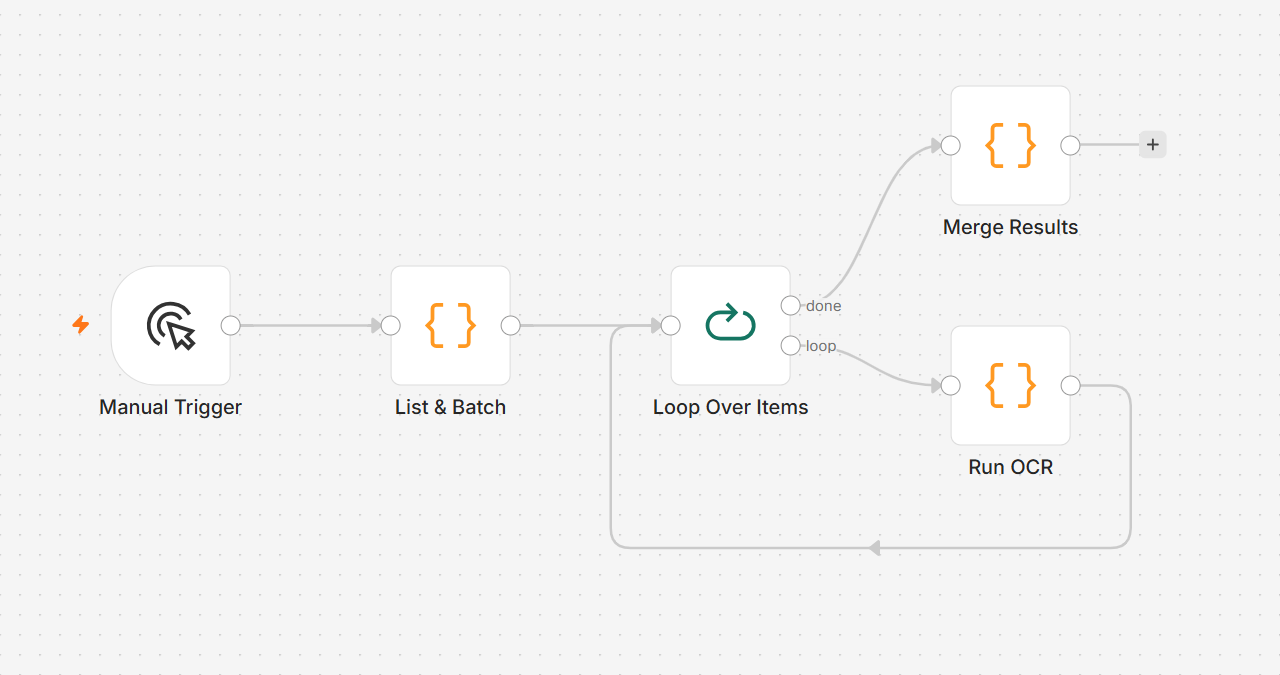
Process description: Manual Trigger startup → List & Batch batch grouping → Loop Over Items item-by-item processing → Run OCR execution identification → Merge Results merge results loop to ensure that each data is completely verified.
Effectiveness comparison
Before optimization · Traditional OCR
- Approximately 3-4 of every 10 photos require manual verification.
- Single model single identification
After optimization · Smato AI OCR
- Less than 1 in every 10 is worth paying attention to
- Multi-perspective cross-validation + automatic deep analysis
core value
This is not the result of a "stronger" model, but aArchitecture-level breakthrough. When the anomaly rate drops from 30% to less than 5%, it brings not only an improvement in technical indicators, but alsoQualitative changes in work processes:
Release manpower
No need for a dedicated person to check each card one by one
Data is credible
90-95% directly credited
Exception management
From "full inspection" to "spot inspection"